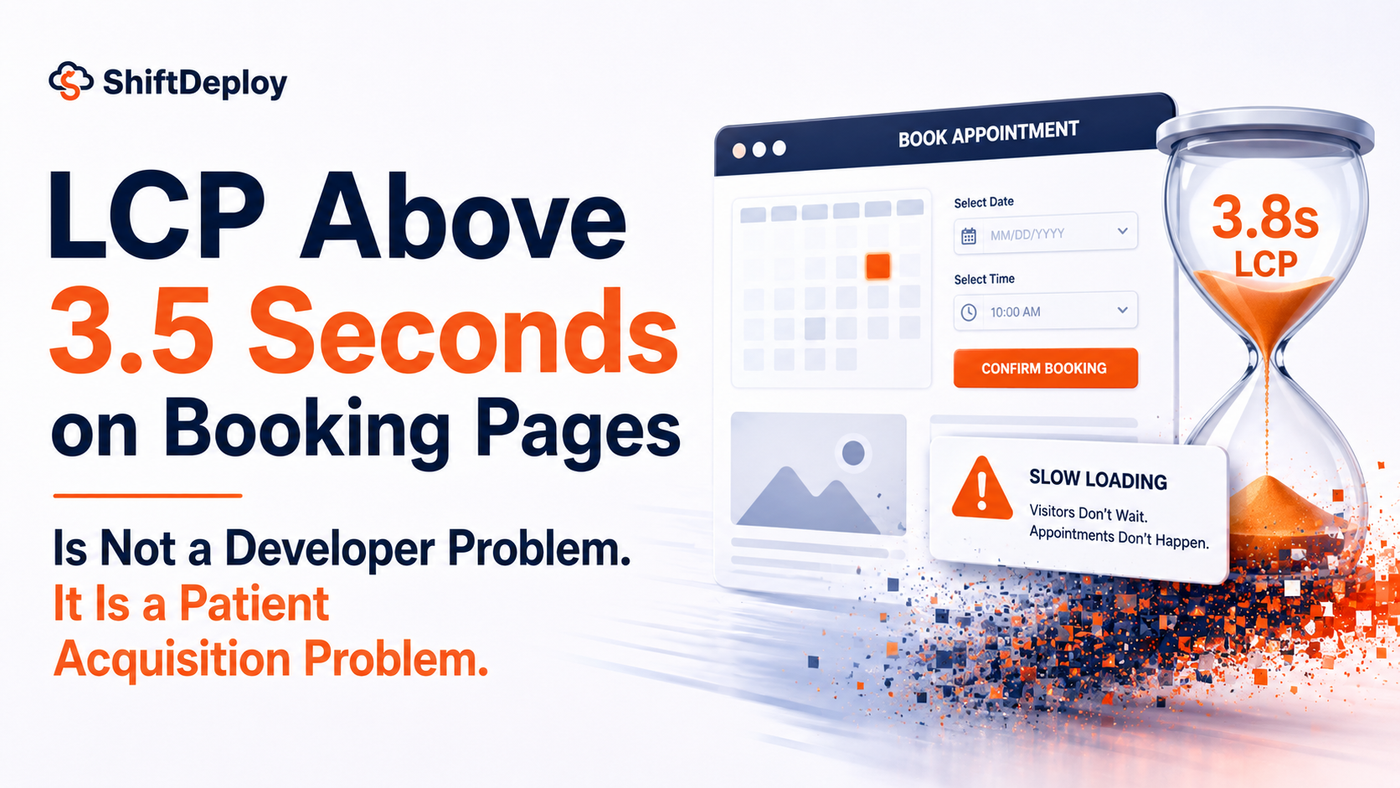
Largest Contentful Paint on a dental clinic or med spa booking page is not a technical curiosity for developers to resolve in a sprint. It is the precise interval during which a patient has committed their intent and your practice has returned nothing. Every millisecond of that interval is your infrastructure communicating something to that patient before a single member of your staff has spoken a word.
As page load time increases from 1 to 5 seconds, bounce rate probability increases by 90%. Outgrow On a general e-commerce page, that statistic belongs in a performance audit. On a booking page for a $400 med spa appointment or a $3,500 dental implant consultation, it belongs in a revenue conversation.
Dental practices with slow sites lose 50% of visitors before pages fully load, directly impacting consultation bookings and treatment enquiries. Curogram These are not cold traffic visitors who were browsing out of curiosity. These are patients who found your practice, evaluated your services, and navigated to your booking page with a specific intent. The LCP score is what they encountered when they arrived.
What LCP Is Actually Measuring on a Booking Page
Largest Contentful Paint measures the time from page request to the moment the largest visible content element renders on screen. On most practice booking pages, that element is either a hero image, a heading, or the booking widget itself.
The critical detail for practice owners is this: LCP on a booking page is not measuring how long it takes to see the page. It is measuring the interval between the patient's decision to act and the moment the interface that allows them to act becomes visible.
Good LCP occurs within 2.5 seconds of when the page starts loading. Mangomint That threshold is not arbitrary. It is the window within which a user's attention remains anchored to the page rather than shifting to the back button. On a booking page, losing that attention is not a UX event. It is a revenue event.
Portent's research demonstrates that sites loading in 1 second achieve 39% conversion rates, while this drops to 1.9% at 2.4 seconds and plummets to 0.6% at 5.7 seconds. WPForms That is not a marginal decline. Between 1 second and 5.7 seconds, you lose 98.5% of your conversion potential. On a page whose sole purpose is to convert a patient's intent into a confirmed appointment, that curve describes the revenue consequence of your current server infrastructure.
Why Booking Pages Specifically Fail Core Web Vitals
A standard practice website homepage typically loads faster than its booking page. This is not accidental. Booking pages carry a specific payload that other pages do not.
The typical dental clinic booking page built on WordPress with Elementor runs a predictable stack of performance failures:
- An unoptimized hero image above the fold, frequently 800KB or larger, loaded without modern formats like WebP or AVIF
- A Calendly embed or custom booking widget that loads after the main page thread, because it is treated as a non-critical resource
- A live chat widget (Tidio, Intercom, or similar) that loads its own JavaScript bundle, blocking the main thread
- A cookie consent banner that fires before any content renders
- A review platform widget (Birdeye, Google Reviews embed) adding another external script dependency
- Google Tag Manager loading 3 to 6 additional analytics and tracking tags
Using too many third-party scripts or loading unnecessary fonts can bloat page load times significantly. Resonateapp Each of these additions was implemented to improve some aspect of the practice's operations or marketing. Each one was added independently, by different vendors, at different times. The aggregate effect on the booking page's LCP was never measured when each was added, because the metric being tracked was the individual feature's value, not the cumulative load it placed on the patient's browser.
The booking widget, the one element on the page the patient needs to take action, loads last. It is render-blocked by everything that loaded before it.
The TTFB Tax That LCP Optimization Cannot Fix
Before a single pixel of your booking page renders, your server must respond to the patient's request. Time to First Byte, the interval between the browser's request and the server's first response byte, is the structural floor beneath every downstream performance metric.
The average Time-to-First-Byte for desktop is 1.29 seconds, and for mobile devices it is 2.59 seconds. Zuko On shared hosting environments, which remain common among small and mid-size practices, TTFB frequently ranges from 600ms to 1,400ms depending on server load and geographic distance from the patient's device.
Here is the arithmetic that matters: an LCP target of 2.5 seconds with a TTFB of 1,100ms leaves 1,400ms for every other resource on the page to load. That is not a comfortable margin when the page is carrying 14 third-party scripts, an unoptimized hero image, and a booking widget that loads after the rest of the DOM.
A one-second improvement in LCP can cut bounce rates up to 14% and boost conversion rates by 13%. Brixon But a one-second LCP improvement delivered on top of a 1.1-second TTFB is not the same investment as one delivered on a server that responds in 80ms. The TTFB cannot be compressed out, cached away, or eliminated with image optimization. It is the consequence of the server infrastructure the practice is on. Every performance optimization above it is working from a deficit the server set before the browser loaded a single byte.
This is why practices that invest in website redesigns without changing their hosting infrastructure report no meaningful improvement in booking conversion. The design was not the ceiling. The server was.
What This Costs a Practice in Measurable Terms
The calculation is not theoretical. Apply it to your own numbers.
A dental practice receiving 800 monthly sessions to its booking page with a current LCP of 4.2 seconds is losing a quantifiable portion of those sessions to abandonment before the booking interface renders.
A 55% LCP improvement halved the bounce rate in a documented case study. Form QR Code Builder Applied conservatively, moving from a 4.2-second LCP to a 1.8-second LCP on this practice's booking page, recovering 90 to 120 sessions that would have otherwise bounced, the revenue consequence at a 12% form-to-booking conversion rate and $380 average ticket is:
- 90 recovered sessions x 12% conversion = 10.8 additional appointments
- 10.8 x $380 = $4,104 per month
- $49,248 per year
That figure does not require a single additional marketing dollar. It does not require more traffic. It requires that the booking page renders its primary content, the calendar interface, within the window the patient's attention is available to act on it.
The gap is not in the analytics. It is in what the analytics never record: the session that ended before the booking interface rendered.
The Mobile Dimension Makes This Worse
The average time it takes for a mobile site to fully load is 22 seconds, and 10.3 seconds for a desktop. Formstory That figure covers all websites, not specifically booking pages. Among practices running unoptimized WordPress sites on shared hosting, the mobile load time for booking pages is frequently worse than the desktop figure, because mobile browsers process the same JavaScript payload on slower hardware with more constrained network conditions.
Most dental searches happen on smartphones, and if your site takes too long to load on mobile, you risk losing patients who are on the go, exactly the audience most likely to call or book an appointment immediately. Prospyrmed
The patient searching for a dental emergency consultation at 9pm is on a phone. The patient searching for a cosmetic treatment during their commute is on a phone. The patient who found your practice through a Google Maps result is navigating to your booking page on a phone. The mobile LCP on that booking page is the first operational impression your practice makes on the segment of patients most likely to convert quickly.
Only 37% of mobile pages achieve good INP when using user behavior tracking scripts. WPForms Most practice websites are running multiple behavior tracking scripts. Most are not aware that those scripts are specifically degrading the responsiveness of their booking page on mobile.
The Practice Owner's Diagnostic Checklist
Before attributing low booking conversion to marketing, pricing, or competition, these measurements isolate whether the performance layer is the actual constraint:
- Run your booking page URL through Google PageSpeed Insights. Record the LCP score on mobile specifically, not desktop.
- Check your TTFB. A score above 600ms on mobile indicates a hosting infrastructure problem that image optimization will not solve.
- Count the number of third-party scripts loading on your booking page. If the count exceeds 8, the booking widget is almost certainly not loading in the patient's first-view window.
- Check whether your booking widget is render-blocked. If it appears in the lower section of the PageSpeed "Reduce unused JavaScript" recommendations, it is loading after the patient's initial attention window.
- Compare your mobile LCP to your desktop LCP. A gap larger than 2 seconds indicates a mobile-specific rendering problem, often unoptimized images or JavaScript that is not deferred.
Each of these checks produces a number. That number either confirms the booking page is performing within the patient's attention window, or it explains a portion of your conversion rate that no marketing optimization can recover.
Conclusion
LCP on a booking page is not a developer metric. It is the interval during which your practice either earns or loses the attention of a patient who has already decided to book.
Page speed is not just a technical metric. It is your first impression. American Med Spa Association On a booking page specifically, it is the first impression that determines whether the patient ever reaches the form, the calendar, or the confirmation screen at all.
A slow booking page does not announce its failures. It produces silence: sessions that end before conversion, patients who navigate away without a record of why, and a conversion rate that sits flat month after month while every other variable gets optimized around it.
The booking page is the highest-intent page on your website. It deserves the highest-performance infrastructure on your website. In most practices, it receives neither.

ShiftDeploy Technical Team
ShiftDeploy Team